
You don't need more power. You're missing a different variable.
You already own the gear. A percussion gun, maybe two, a foam roller, a lacrosse ball rattling around the bottom of your bag. You know the warm-up before a session and the ache after it. So this isn't a pitch about whether recovery matters, you're well past that argument.
It's about one specific thing none of that gear can do, and why the knot that ends your runs or shortens your lifts is sitting in exactly the same spot it was six months ago. It isn't a discipline problem, and it isn't a power problem. It's a missing input.
Once you can see the variable that's missing, the fix stops being "buy a stronger motor" and becomes obvious.
Speed was never the missing ingredient. Leverage was.
The fix wasn't a stronger motor.
Here's an arc that'll sound familiar. One of the runners we built the early units for had a knot deep in the glute and hip that turned every run into a countdown, fine for two miles, then a deep ache that shortened her stride and ended the session.
The standard fixes came out in order. A percussion gun she hammered the spot with before every run. A foam roller she rolled on until the area went numb. A stretching routine. A handful of PT visits that helped right up until they stopped. Everything took the edge off. Nothing cleared it. She'd quietly shelved her long runs and half-accepted that this was just her body now.
What finally moved it wasn't more power, it was a different input: pinning the exact spot and leaning her bodyweight into it, held in place, the way you'd dig a thumb into a stubborn trigger point if your thumb could take the load. The first real session, the spot actually released instead of going quiet for an hour. Within a couple of days the ache stopped cutting her runs short. She was back to full distance inside a week, and stayed there.
That's the arc Kontour was built around. Not a stronger motor. A different variable.
It was never a power problem. It's a pressure problem.
A muscle knot, a myofascial trigger point, releases under sustained, targeted, leveraged pressure. Aimed at one spot and held long enough for the tissue to actually let go, the same principle a therapist uses when they find the spot, lean in, and hold until it releases. That's the variable that matters. It's also the one a percussion gun structurally can't produce.
A gun taps, fast, across the surface of the muscle. It's motion without leverage, there's no way to load real bodyweight into a single point and keep it there, so it rides across the top of the knot instead of sinking into it. Speed isn't the missing ingredient, and neither is a bigger motor. That's the whole reason the category has one universal review: "it buzzes, but the knot's still there." Your gun isn't broken. It's just built around the wrong variable.
Here's why holding pressure works when tapping doesn't. Press firmly into a trigger point and hold, and you briefly limit blood flow to that exact patch of muscle. Ease off, and fresh blood floods back in. That squeeze-and-release, repeated on the spot, is what coaxes a knotted band of muscle to finally let go, it's the mechanism behind a therapist's thumb, sometimes called ischemic compression, and it depends entirely on holding steady pressure in one place. A vibrating head can't hold anything. It's off the spot a hundred times a second.
And the mechanism itself is well documented, it's the pressure doing the work, not the motor. A 2012 McMaster University study found that massage reduces inflammation in skeletal muscle and promotes mitochondrial growth, the cellular machinery your training depends on. The soreness studies above measured the same thing from the outside: real, hands-on pressure meaningfully lowers DOMS and speeds recovery. Even tactical-athlete research points the same way, self-applied pressure and myofascial release show up repeatedly as recovery tools against the soreness of heavy, loaded physical work. In every case the input is sustained manual pressure, not a vibrating head.
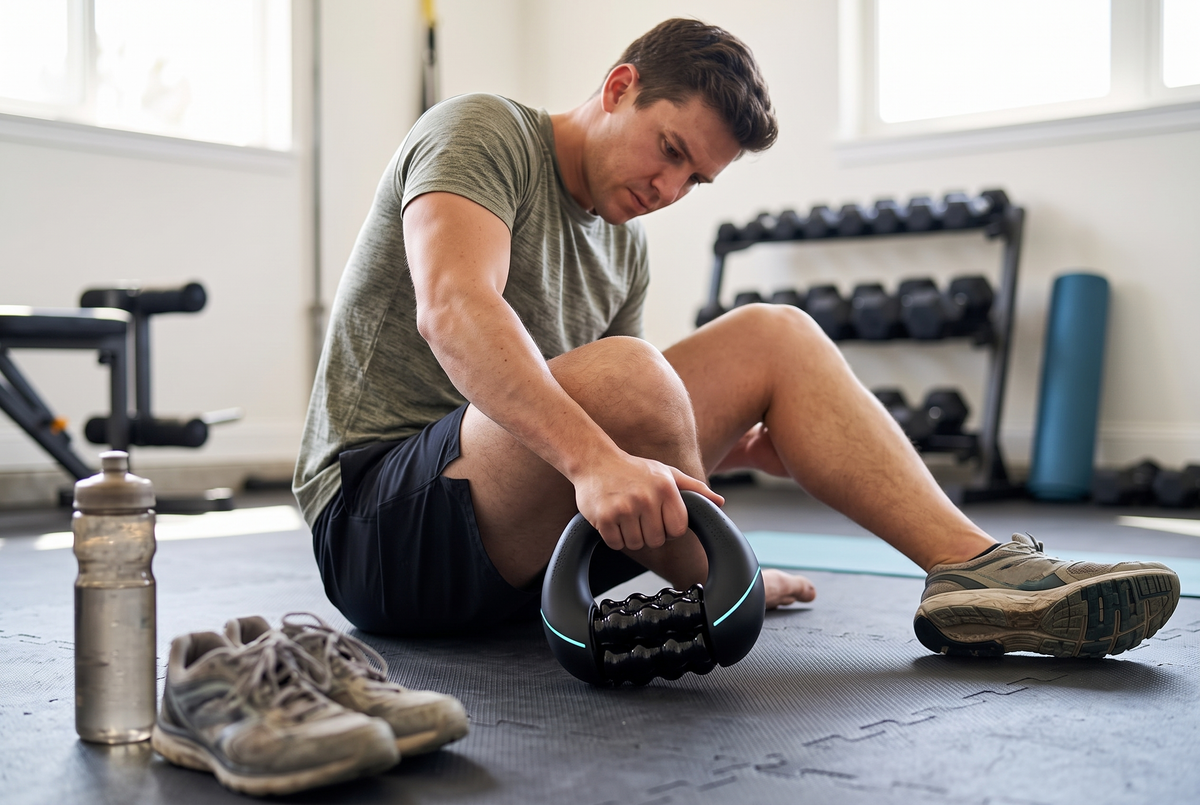
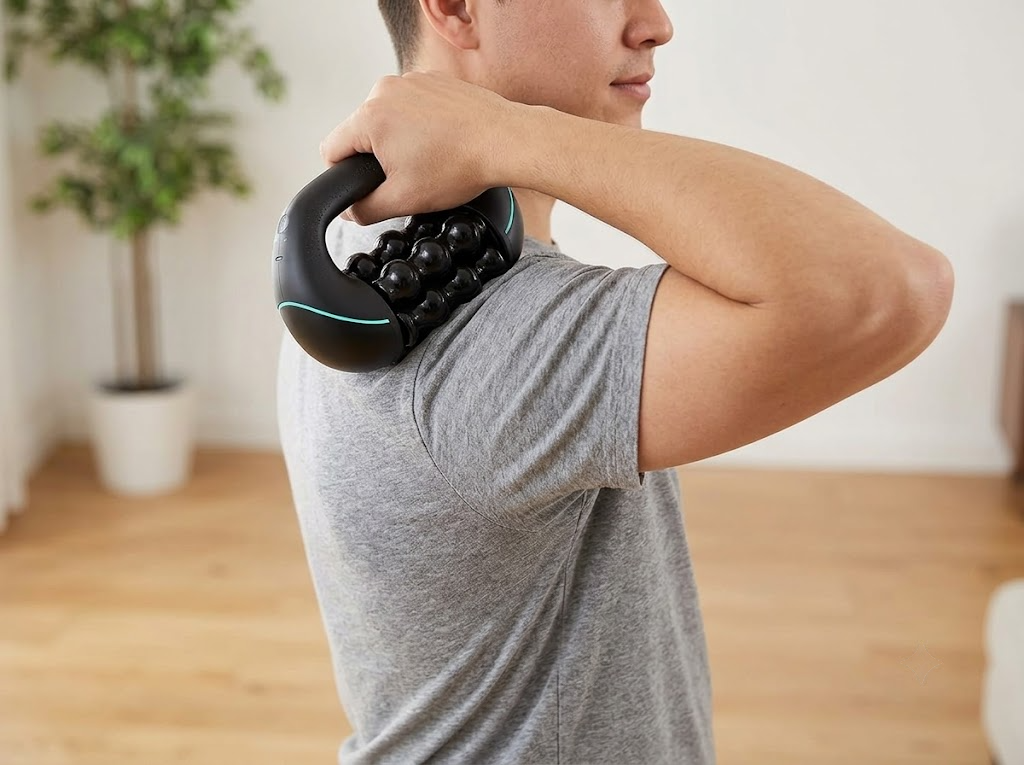
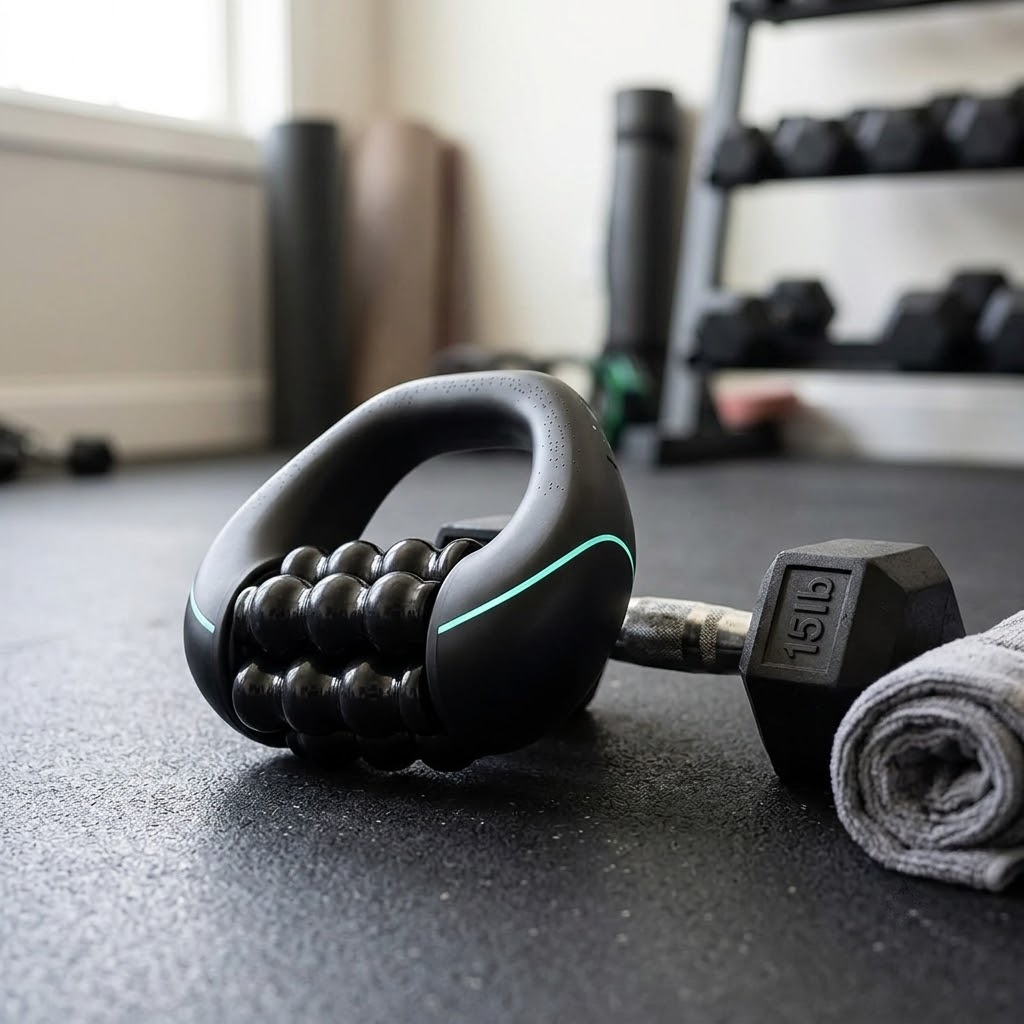
Kontour is built to give you that exact input. It's shaped like a kettlebell so you can grip the closed loop, press the dual counter-rotating rollers into the spot, and lean your own bodyweight in, the same sustained, directional pressure a therapist's hands apply, aimed exactly where you need it. We call the mechanism Loop-Leverage Rolling. Cordless and USB-C rechargeable, up to four hours per charge, with three intensity levels, one hand or two. Ready the moment tension is, no cord, no appointment.
How to actually use it on a knot.
The technique is the whole point, and it's simple. Find the spot, the one you already know. Grip the loop, press the rollers into it, and lean a bit of your bodyweight in until you feel a deep but tolerable pressure, a 6 or 7 out of 10, never sharp pain. Hold there, or roll slowly through the length of the muscle, for 60 to 90 seconds. Breathe, ease off, and you'll usually feel the spot soften. Do it after a session, or any time the knot flares. No routine to memorize, no settings to learn.
Cordless · 3 intensity levels · 45-night trial
Massage guns, honestly.
None of this means your gun is useless. It's genuinely good at a few things, and it's worth being straight about them.
A gun is good at
Fast, broad warm-up. Driving blood flow to a large area, loosening things up pre-session, shaking out general soreness. For that, it works.
Only Kontour does this
Sustained, leveraged pressure on one exact point, held. The input that actually releases a trigger point, and the one a gun structurally can't produce.
Use both, honestly. Warm up broad with the gun, then put real pressure into the one spot that keeps ending your sessions. They aren't competitors, they do different jobs. The mistake was ever expecting the gun to do this one.
Getting back to full sessions.
Strip away the wellness language and here's what this is really about: finishing the run instead of turning back at mile two. Getting under the bar for the last set without the shoulder locking up. Making it through class, through the game, through the season, without one recurring spot deciding when you're done for the day.
And recovery you'll actually keep up with is the kind that fits your life, 90 seconds on the spot after a session, on the couch, in the locker room, in a hotel room the night before a race. Cordless matters here for a boring but real reason: the tool you don't have to plug in or book is the one you'll still reach for on day 40, not just day 1. Consistency is what moves a recurring knot, and consistency only happens when the tool is genuinely there.
You've already made the case for recovery, it's in your budget and your routine. This just closes the one gap in the kit: the tool that finally handles sustained pressure, so the knot that's been quietly shortening your sessions stops being the thing that ends them.
45-night trial · money-back guarantee
LOW RISK, BY DESIGN
45 nights to prove it earns a spot in your kit.
Given what a decent recovery setup already costs, this part is simple. Use Kontour for 45 nights. If it doesn't reach the spot better than what you're already using, send it back for a full refund, no questions asked. Test it against your gun on your own worst knot, and keep whichever one actually works.
- 45-Night Trial
- Money-Back Guarantee
- No Questions Asked
Cordless · 45-night trial · money-back guarantee
Kontour is a personal massage device intended to help relieve everyday muscle tension and support recovery. It is not a medical device and is not intended to diagnose, treat, cure, or prevent any disease or medical condition. If you have an injury or persistent or severe pain, consult a qualified healthcare provider before use. Individual results vary.