

You already know exactly where it is.
You don't need a diagram. You could put a finger on it right now, that spot beside your shoulder blade, or low in your back, or where your neck meets your traps. It migrates a little. It flares when you reach for a dish, or sleep on it wrong, or look down at your phone too long. Then it settles back into being the thing that's just always there.
You've probably had it for years. And you've almost certainly tried to make it leave, foam rollers, a massage gun, a shiatsu pillow, stretches off a video, maybe rounds of physical therapy. Some of it helped for an afternoon. None of it made the knot actually go.
Here's the part nobody says out loud: that's not a discipline problem. It's not in your head, and it's not because your body is uniquely broken. It's because the tools you reached for were never built to apply the one thing a knot actually responds to.
It's not a cure but bandaids are better than nothing.
— sentiment from a chronic-pain community forum
It started with one stubborn knot and a drawer full of things that didn't work.
Kontour didn't come out of a lab. It came out of frustration.
The founder spent years at a desk with a knot under the left shoulder blade that never fully let go. The usual progression followed: a $200 percussion gun that buzzed against it for ten minutes and changed nothing. A shiatsu pillow that kneaded a fixed path an inch from the actual spot. Two rounds of physical therapy that ended the moment insurance decided they were done. A nightstand drawer that slowly filled with devices that all promised the same thing and all quit in the same place, right at the surface.
The turning point wasn't a breakthrough. It was a bad night. Lying there unable to get comfortable, pressing a thumb into the spot as hard as a thumb can go, came the flash of the obvious: it only ever felt better when real, steady pressure was leaned directly into it. Not tapped. Not vibrated near. Pressed, and held.
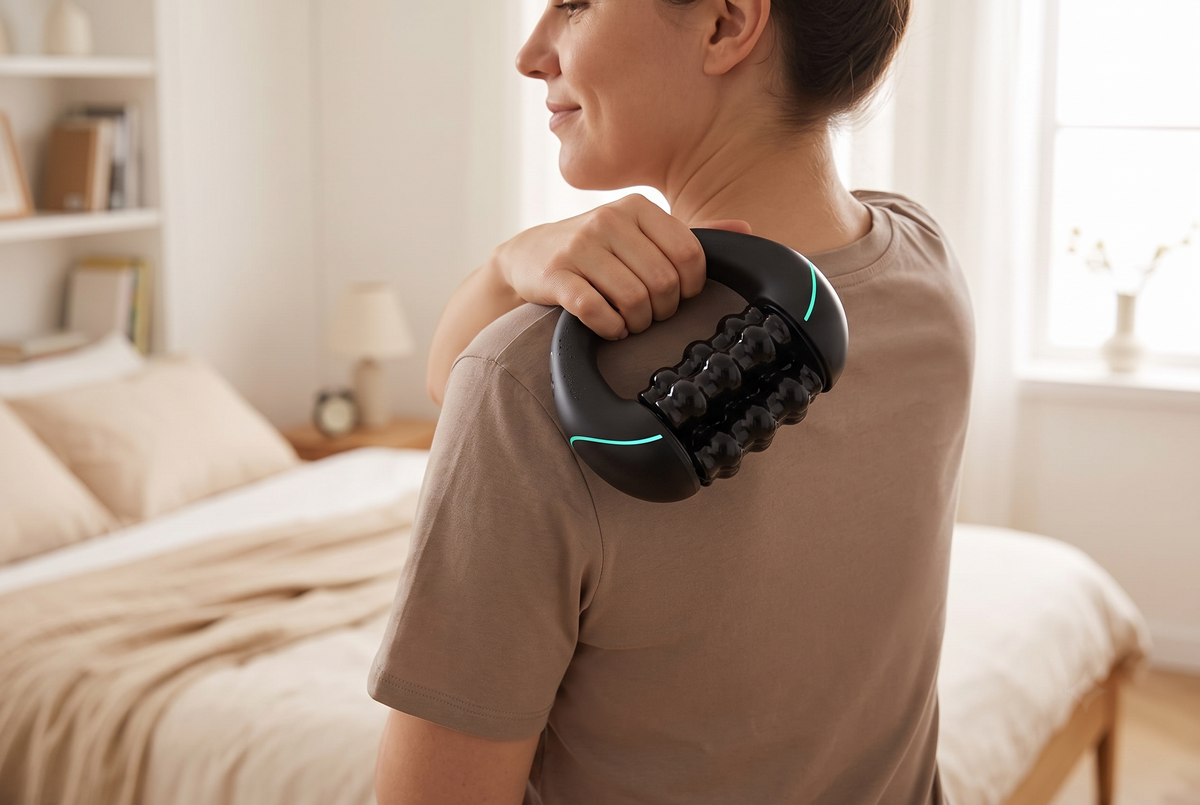
The problem is you can't hold that pressure on your own back for ninety seconds with a bare hand, your wrist gives out first. So the first rough version was exactly that fix: a handle you could grip and load your bodyweight through, with rollers underneath to work the pressure into the muscle. It was ugly. It also worked on that knot better than anything in the drawer.
This isn't a personal failure. It's a system that runs out before you do.
If you've felt dismissed, you're not imagining it. Somewhere along the way the message became that this is yours to quietly manage, forever. It's worth being clear about why that happened, because it isn't about you.
Most insurance plans cap physical therapy at somewhere between 20 and 60 visits a year, regardless of what your body actually needs, and many require fresh authorization every two or three visits. When the cap hits, the care stops, whether or not you're better. And the out-of-pocket math is brutal: the average privately-insured patient pays around $192 for a single session. The system tends to wait until you're barely functional to approve help, then stops paying before the job is done.
I'm just desperately looking for answers because doctors are clueless and the meds were hurting me more than helping me.
— sentiment from a chronic-pain community forum
Here's the part that should make you a little angry, and a little hopeful: this pain isn't inevitable. Sedentary jobs have risen more than 83% since 1950, and many of us now spend up to 80% of our waking hours sitting. But sitting itself isn't the whole story. Researchers who studied the Hadza, a modern hunter-gatherer group, found they sit about as many hours a day as we do, yet report dramatically lower rates of back pain. The difference they point to isn't how much you sit, it's how you move and hold your body the rest of the time.
Which means the tension you carry has a cause. It's not a sentence written into your spine, it's a pattern, and a pattern can be worked on.
It was never a power problem. It's a pressure problem.
Here's the mechanism nobody in the massage-gun aisle wants to explain, because their product is on the wrong side of it.
A muscle knot, a myofascial trigger point, releases under sustained, targeted, leveraged pressure. Not speed. Not vibration frequency. Pressure, aimed at one spot and held long enough for the tissue to let go. That's the whole variable.
A percussion gun can't give you that. It taps, fast, across the surface of the muscle. It's motion without leverage, so it never settles into the knot, it skips across the top of it. That's the exact reason the entire category shares one universal review: "it buzzes, but the knot's still there." It isn't that your gun is defective. It's that no gun can do the thing.
A percussion gun
Taps fast across the surface. No way to lean weight in, no sustained pressure, so it skips over the top of the knot.
Kontour
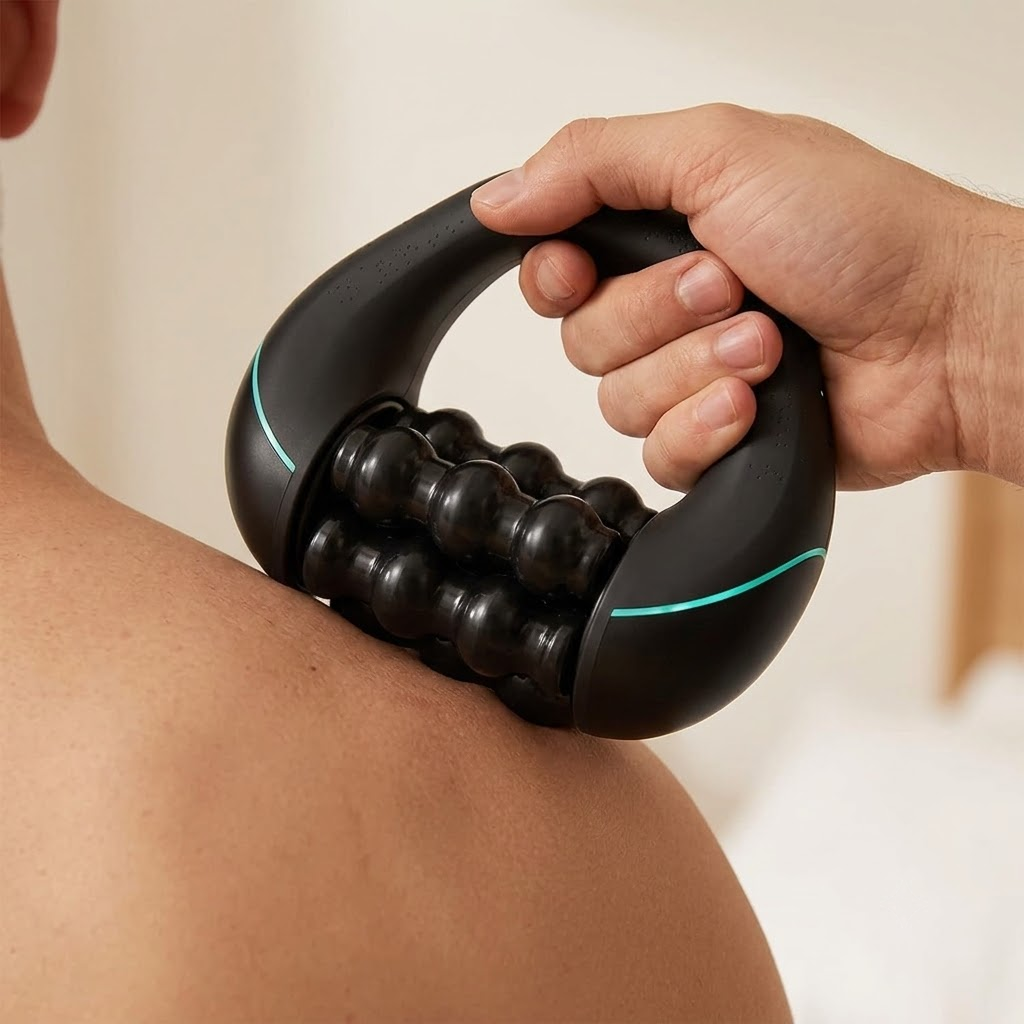
You grip the loop and press the rollers into the spot with your own bodyweight, steady, aimed, held. The pressure a thumb gives, without your wrist giving out.
Think about why a good massage therapist's hands work. It isn't that their thumbs vibrate. It's that they can lean their bodyweight into one exact spot and hold it. Sustained, directional pressure. That's the thing.
Kontour is shaped like a kettlebell for one reason: so you can do that yourself. You grip the closed loop, press the dual counter-rotating rollers into the knot, and lean your own weight in, the same sustained, directional pressure a therapist applies, now under your control and pointed exactly where you need it. We call the mechanism Loop-Leverage Rolling. It's cordless and USB-C rechargeable, up to four hours per charge, with three intensity levels, and it works one-handed or two. No cord tethering you to a wall. No appointment to book. It's ready the moment tension is.
Cordless · 3 intensity levels · 45-night trial
What this is, and what it isn't.
We're not going to insult you with the promise you've already heard too many times. So, plainly:
Kontour is not a cure. No handheld tool is, and no honest one will tell you otherwise. If your pain is sharp, sudden, radiating, or the result of an injury, that's a conversation for a doctor, not a roller, please treat it that way.
What Kontour does is one specific, real thing: it lets you apply sustained, leveraged pressure to release everyday surface muscle tension, the tight, knotted, "always there" kind, on your own schedule, as often as it flares. That's a well-established way to get relief. It isn't magic. It's leverage. We'd rather tell you exactly what it does and let it earn your trust than oversell it and lose you the way the last five things did.
A PT has no intuition for how difficult something is, what your range of motion is, or pain tolerance.
— sentiment from a chronic-pain community forum
You already know your own body better than a fifteen-minute appointment ever could, where the spot is, how much pressure it wants, when it flares. Kontour just hands you the leverage to act on what you already know, the moment you need it, without asking anyone's permission first.
THE PART THAT MATTERS MOST
Try it for 45 nights. Send it back if it doesn't deliver.
We know this category's reputation, devices that feel great for two weeks, then quietly die right after the return window closes. That's exactly why the guarantee isn't buried in fine print here. It gets equal billing with everything above.
Use Kontour for 45 nights. If it doesn't reach the knot better than anything you've tried, send it back for a full refund. Money-back guarantee, no questions asked. The risk is entirely ours, because we'd rather earn a customer than trap one.
- 45-Night Trial
- Money-Back Guarantee
- No Questions Asked
45-night trial · money-back guarantee
You're not chasing a cure. You're chasing your evenings back.
Be honest about what you actually want. It was never "less pain" in the abstract. It's sleeping through the night without shifting to dodge the sore spot. It's getting through a workday without the 3 p.m. lockup. It's the hobby you quietly stopped, the walk, the run, the class, because it wasn't worth what came after. It's being fully in the room with the people you love instead of half-managing a knot.
You made peace with not being cured a long time ago. That's not what this is about. This is about having enough relief, on demand and on your own terms, to get back the parts of your life this thing has been quietly taking. If you have that kind of relief whenever you need it, you get to go back to being the person the pain put on hold.
That's the whole point of Kontour. Not a miracle. Just leverage, in your hand, ready when you are.

Cordless · 45-night trial · money-back guarantee
Kontour is a personal massage device intended to help relieve everyday muscle tension. It is not a medical device and is not intended to diagnose, treat, cure, or prevent any disease or medical condition. If you have a diagnosed condition, an injury, or persistent or severe pain, consult a qualified healthcare provider before use. Individual results vary.